Wearable Robotics

Soft Robotic Gloves, Exosuits & Rehabilitation

Overview

Wearable robots have the potential to restore lost function and enhance human capabilities. My research focuses on creating seamless interfaces between the human body and robotic systems.

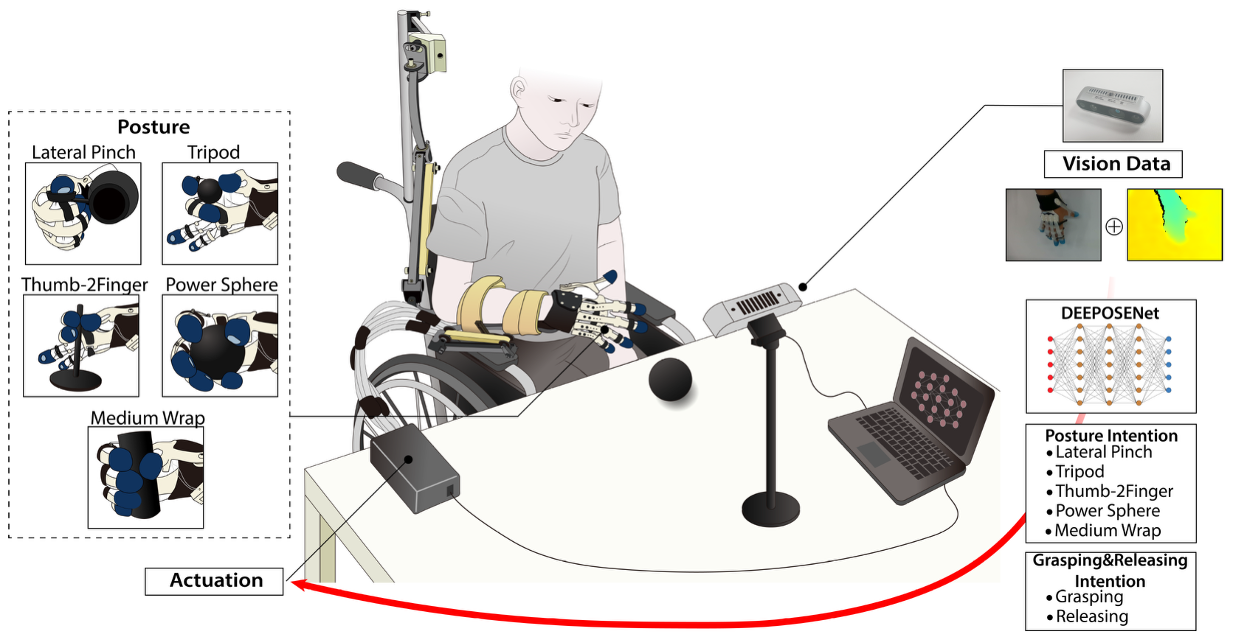
I work on Soft Wearable Gloves for rehabilitation and assistance, using deep learning to estimate fingertip forces on deformable objects. Additionally, I am developing vision-based intention detection systems that allow users to control these devices intuitively.

Wearable Robotics

Key Publications

Learning Fingertip Force to Grasp Deformable Objects for Soft Wearable Robotic Glove With TSM

Eojin Rho, Daekyum Kim, Hochang Lee, Sungho Jo

Proposed a deep-learning model that can accurately estimate the fingertip forces applied to deformable objects using motor encoder values, motor current, and wire tension. Our model estimates stiffness of the grasped objects and incorporates it for predicting the fingertip forces, achieving a 45% increase in accuracy.

Wearable Glove TSM Force Estimation

Multiple Hand Posture Rehabilitation System Using Vision-Based Intention Detection and Soft-Robotic Glove

Eojin Rho, Hochang Lee, Yechan Lee, Kun Do Lee, Jungwook Mun, Min Kim, Daekyum Kim, Hyung Soon Park, Sungho Jo

Proposed a hand rehabilitation system comprising a vision-based intention detection framework and an 8-degree-of-freedom soft-robotic glove. The framework analyzes images and depth data to predict intentions for multiple hand postures, helping stroke survivors actively train.

Rehabilitation Vision-Based Intention Detection

Point Cloud-Based Grasping for Soft Hand Exoskeleton

Chen Hu, Enrica Tricomi, Eojin Rho, Daekyum Kim, Lorenzo Masia, Shan Luo, Letizia Gionfrida

Research on point cloud-based grasping strategies for soft hand exoskeletons.

Soft Exoskeleton Point Cloud Grasping